Understanding Roof Trusses: The Backbone of Your Sydney Home’s Roof

Listen to the minisode.
We don’t look at our roofs at all. By looking, I simply mean paying attention to it; we don’t. We only pay attention to it when it’s already too late, and the roof has lost the last war against all the conditions.
The actual guts of your roof? Completely invisible. Tucked away in the ceiling, up in the attic, where you only go when the Christmas decorations are buried too deep. That’s your roof truss. Sounds boring, I know. But it’s basically the backbone of your entire house. Without it? You’ve basically got a very expensive pile of tiles with nothing holding it up. Waiting to come down.
What does it actually do?
Everything, basically. It holds the weight. Keeps the shape. Stops your roof from folding like a cheap deck chair in nasty weather.
That humidity off the coast doesn’t just make your hair frizz—it gets into timber, into joints, into places you can’t see. The winds we get? I’ve seen gutters ripped clean off. And the sun here? Brutal. Bakes your roof all day, then some storm rolls in out of nowhere and everything’s expanding, shrinking, basically giving the whole structure a proper working over.
You tell yourself you’ll sort it later. Then later turns into “when I’ve got a sec,” and before you know it, there’s a crack running right across your ceiling, your bedroom door needs a proper shove to close, and you’re standing there staring up at the roofline like… was that always dipping like that?
I’ve watched this exact story play out more times than I can count. At Austopline, it’s basically our opening chapter. Someone calls us in a panic because what started as a nothing problem is now a five-figure repair job. And the worst part? It was preventable. If someone had actually looked at the trusses earlier—properly looked, not just glanced up and gone “yep, still a roof”—we could’ve fixed it for way less.
No one enjoys discussing roof trusses, but I know it can get quite bad when there is a crack on your roof and you just don’t know how it got there. These problems can only be resolved if you have a certain amount of understanding of roof trussing. These cracks can’t be your next DIY project.
So let’s see how that unfolds.
No jargon. No “industry-leading solutions” crap. Just what you need to know, from someone who’s spent too long crawling around in other people’s ceilings.
What Is a Roof Truss?
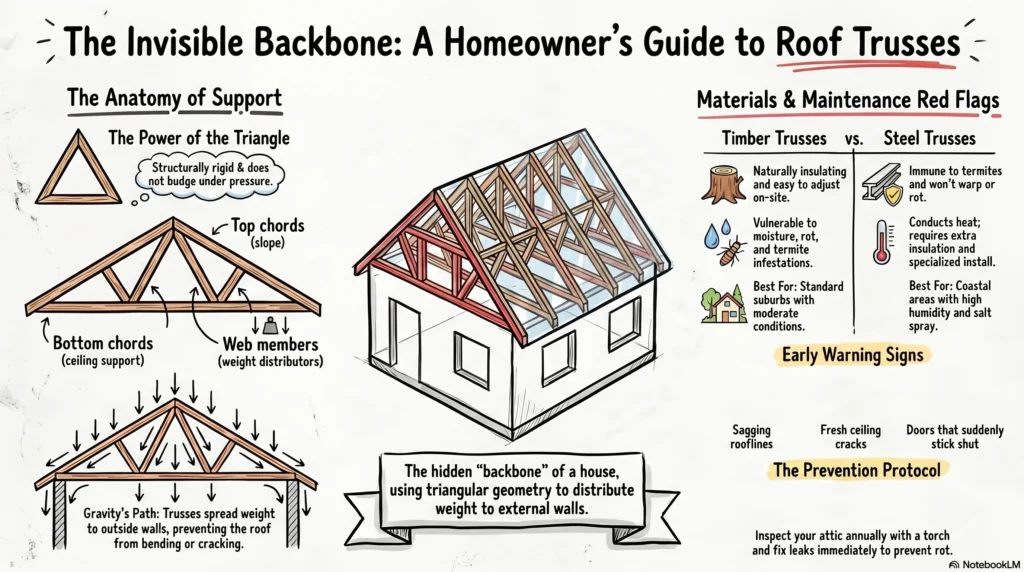
A roof truss is basically a frame made of wood or steel, all joined together. And here’s the clever bit: it’s built out of triangles. Loads of them.
Why triangles? Because they’re rock solid. Look at any bridge or crane—same idea. Triangles just don’t budge.
They work by spreading the weight out. Instead of everything pressing down on one spot, the truss sends the load straight to your outside walls. That stops your roof from bending, cracking, or worse.
Old-school rafters? They were built piece by piece, right there on your property. Slow, fiddly work. Most modern trusses come prefab—made in a factory, basically. All of the measurements and cuts are made by machines and then transported to your site and lifted by crane. It’s faster, safer, and you know it has been done well.
A basic truss has three parts:
- Top chords: The slanted edges that form your roof’s slope.
- Bottom chord: The flat piece at the bottom. Holds up your ceiling and stops your walls from pushing outward.
- Web members: The crisscross bits inside the triangles. They connect the top and bottom and spread the forces around.
Every piece matters. One weak link and the whole thing feels it.
Why Roof Trusses Actually Matter
Your roof cops it every single day. Its own weight, plus rain, leaves, sometimes snow if you’re further south. The wind is trying to lift the whole thing off. And that Sydney sun, baking everything until it expands, then contracts when it cools. Over and over.
A good truss handles all that pressure and sends it where it needs to go. Without strong trusses, your roof starts sagging within a few years.
In Sydney, this is especially critical. Our weather? Turns on a bloody dime. Perfect and sunny Tuesday, Wednesday, you’re getting horizontal rain and wind that howls through every gap. Decent trusses stop the wind from getting underneath and lifting the whole thing off—seen too many roofs end up in someone’s backyard after a big blow. And when the rain’s coming down hard, good trusses don’t let moisture sneak into the weak spots.
Another thing: houses settle. Always. It’s normal. But strong trusses help everything move evenly. If they aren’t present, you have cracked ceiling tiles, sticking doors and walls that look a little tipsy.
Timber vs. Steel: Which One for Your Place?
Building a new roof or replacing an old one? You’ll need to pick a material. In Sydney, it’s usually timber or steel. Both work. Very different beasts, though.
Timber Roof Trusses
Timber’s been around forever. Warm, familiar, cheap. Builders love it because you can just cut it and tweak it right there on-site. Doesn’t fit? Plane it down, shave a bit off, sorted. Timber also insulates naturally—it doesn’t shove heat or cold through your ceiling like metal does, so the place stays more comfortable.
But timber and moisture? They don’t get along. Water finds its way in, and you’re looking at rot. Warping. Twisting. And Sydney termites? They treat it like an all-you-can-eat buffet, those little bastards. Hollow it right out from the inside, and you’d never know. Not until someone sticks a screwdriver in and it goes straight through like butter. So yeah, timber needs someone checking it properly and giving it protective treatments. No shortcuts on that.
Steel Roof Trusses
Steel’s the modern choice. More common in newer homes and bigger builds. Incredibly strong—holds heavier loads without adding much weight. Your walls don’t need to be as thick or reinforced.
Best part? Steel doesn’t rot. Doesn’t warp. Termites won’t touch it. Doesn’t shrink or swell as the weather changes. Stays straight for decades. For coastal Sydney, where humidity and salt are brutal, steel’s often the smarter long-term bet.
Trade-offs though. Costs more upfront. Needs specialised installation—bolts and welds, not just nails. And steel conducts heat like crazy. In summer, that truss gets hot and pumps heat into your home. You’ll need extra insulation to stay comfortable.
So which one?
No single right answer. Depends on your home, your budget, and your location. Near the beach with salt and humidity everywhere? Steel’s usually better. Regular suburb with decent conditions? Timber can be a great, cost-effective choice. Just maintain it properly.
How Roof Trusses Get Damaged
Just because a truss is well constructed doesn’t mean it is well maintained. Damage is not sudden and instantaneous. Damage doesn’t hit all at once. It creeps in slowly, like a tiny crack in your windscreen. You might not notice for months. Maybe years.
Common culprits:
- Water leaks from a cracked tile or rusted valley. Weakens timber, rusts steel.
- Termites in timber trusses. Silent destroyers.
- Dodgy installation from day one. Problems show up later, guaranteed.
- Extra weight from solar panels, air conditioners, and heavy tiles. Not every roof is built for that.
- Storm damage—high winds, falling branches.
- Leave these unfixed, and they start a chain reaction.
Why Damaged Trusses Make Your Roof Sag
A sagging roof is scary. But here’s the thing: the sag is the last step, not the first. It’s the end result of a long, slow breakdown.
One small part of a truss gets weak. Can’t hold its share of weight anymore. So the other pieces work harder. They bend, strain, and weaken, too. Eventually, the whole roofline dips or sinks in the middle.
That’s when you need professional roof truss repair. Delay it, and the sag gets worse. Walls crack. Ceilings can collapse. What could’ve been a simple fix becomes a major rebuild. In some cases, a full roof replacement in Sydney might be your only option if the damage has gone too far.
Signs You Need Roof Truss Repair
- Don’t wait for the sag. Watch for these earlier warnings:
- Roofline looks uneven or wavy from the street
- Fresh cracks showing up in your ceiling or walls
- Doors and windows that suddenly decide they don’t want to close properly
- Weird creaking, popping, or groaning coming from up top
- Actually seeing damage, bending, or rot when you poke your head in the attic
See any of these? Call someone. Now.
Structural Roofing Solutions That Actually Work
Fixing a truss is not a weekend Bunnings job, trust me. You need to find what’s actually causing it and fix the whole thing properly, not just chuck a band-aid on and hope for the best.
At Austopline, we offer roofing solutions in Sydney that keep it simple but thorough. Full inspection inside and out. We hunt for leaks, rot, termites, and bent steel. Then we build a repair plan that actually fits your situation. Sometimes we reinforce existing trusses with new timber or steel plates. Sometimes we replace damaged sections entirely. Severe cases? We rip out old trusses and install brand new ones.
Goals are always the same: make your roof safe, stable, and strong for years to come.
How to Prevent Truss Problems
The best repair is the one you never need. Most truss issues are preventable with basic, regular care.
- Inspect your roof once a year. Get in the attic with a torch.
- Check again after any major storm.
- Fix leaks immediately, even a small drip.
- Make sure your attic breathes. Stale, humid air rots timber fast.
- Don’t bolt heavy stuff to your roof without asking an expert first.
- Quality materials from the start make a huge difference, too. Cheap timber or thin steel won’t last.
- Regular roof maintenance is the single best thing you can do to avoid costly surprises down the track.
Final Thoughts
Your roof trusses? Completely out of sight. Buried behind plaster and tiles, doing their thing where nobody looks. But they’re holding up everything above your head—every single day, no days off. Your family, your gear, and your memories that have been created over the years. Whether you went timber or steel, it doesn’t matter. The same rules are applicable: install it properly, monitor it from time to time, and jump into anything that doesn’t feel right.
So learn what to watch for. That sag you keep telling yourself is “probably nothing”? That fresh crack above the kitchen? Don’t file it under “deal with later.” Later has a nasty habit of turning into “why didn’t I call someone sooner?”
And if you’re standing there unsure, a gut feeling telling you something’s not right? Get someone you actually trust to crawl up there and have a proper look.
A solid roof isn’t just about keeping the rain out. It’s protecting the lot—everything and everyone you care about underneath it. That’s not something you half-arse.