Roof and Truss: The Essential Guide to Structural Integrity for Sydney Homes
Listen to the minisode.
I’ll be honest with you.
Before I owned a house, I never paid attention to the roof. Tiles on top, ceiling underneath. That was it. I never thought about what was in between. Why would I?
Then one day I spotted a crack in the lounge room plaster. Tiny little thing. Barely worth mentioning. So I did what any clueless person does — I ignored it.
Yeah. Big mistake.
Six months later, my ceiling looked like it was gently frowning at me. Not a good look. I called a roofer. He rocked up, had a squiz for about four seconds, and said: “Your trusses aren’t happy.”
Well, I had to dig in online to understand what that is. Since I learned it the hard way, to make things easier for you, I will explain it all here, in detail. When the roofing solution Sydney is concerned understanding what’s underneath your roof is essential.
The Simple Way to Think About It
Forget the technical definitions.
- The roof = your jacket. Tough, weatherproof, what everyone sees from the street.
- The truss = your ribs. Hidden, boring-looking, absolutely essential.
The jacket gets all the attention. But when your ribs are broken, you’re in trouble.
Sydney weather can be the testament. The harsh sun, the salt air near the coast, those random sideways storms that come out of nowhere. If your trusses aren’t happy, your roof isn’t either. Regular roof maintenance can help catch small issues before they turn into disasters.
What’s a Truss, in Plain English?
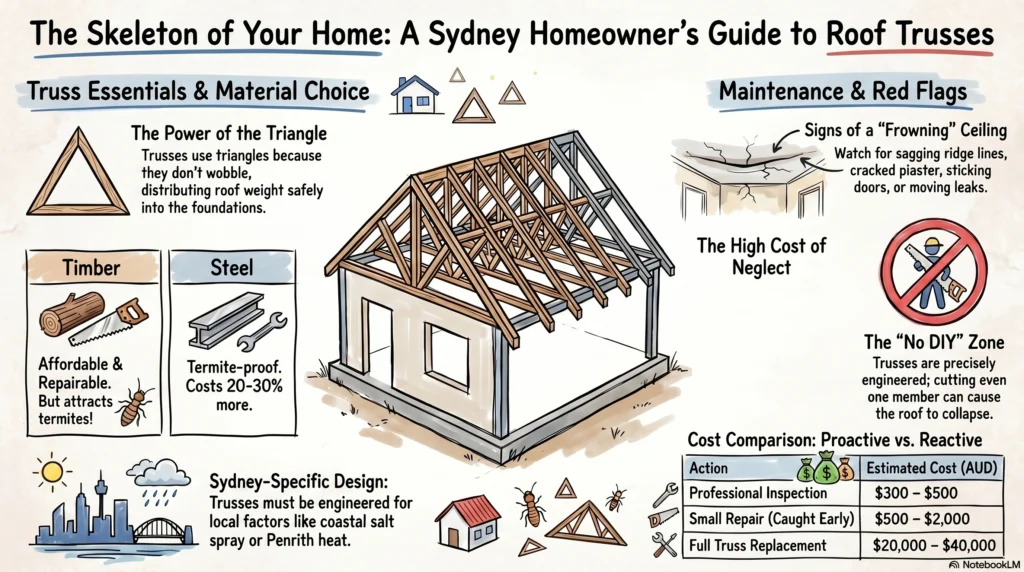
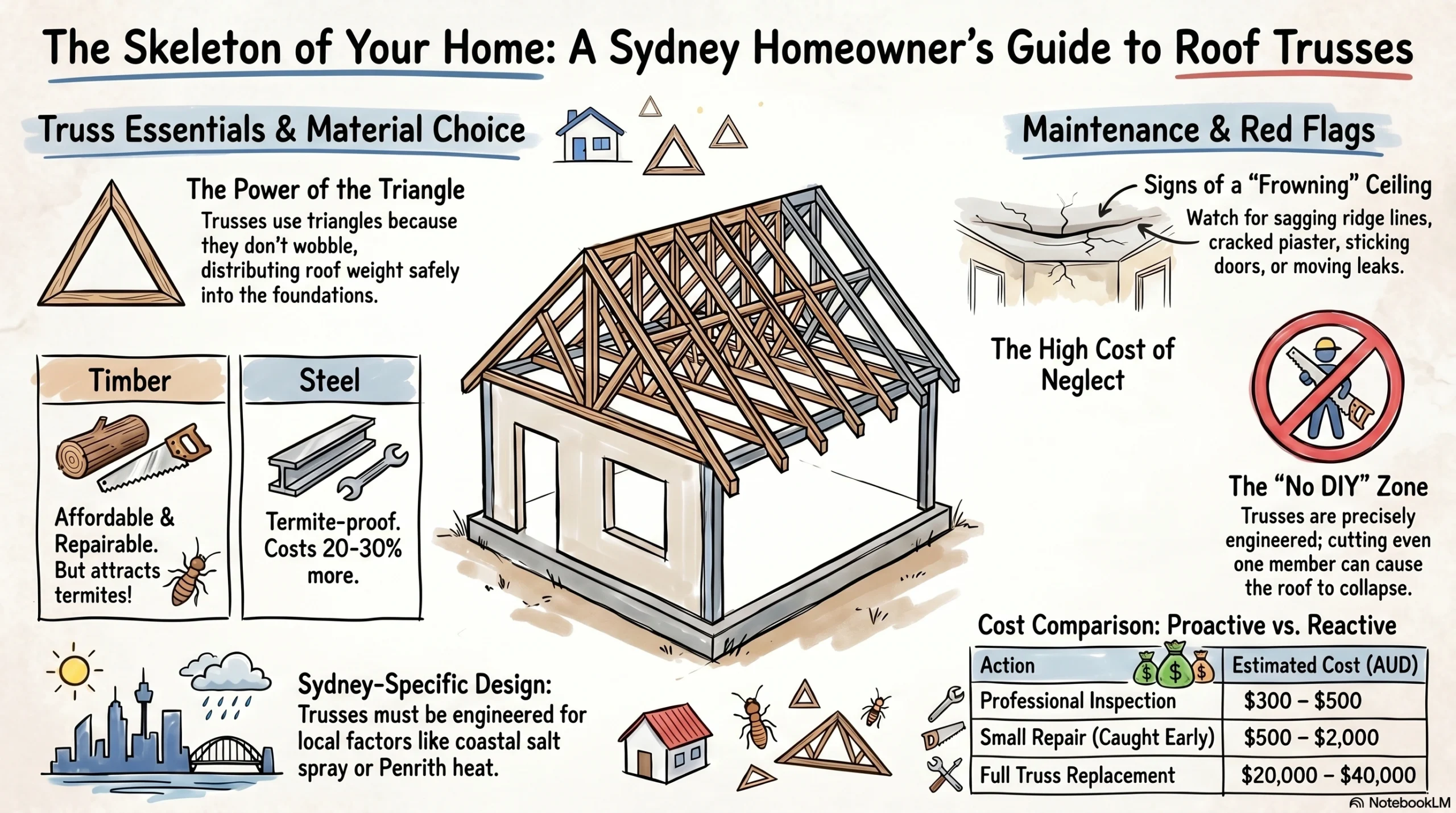
A truss is just a triangle-shaped frame. Timber or steel, connected at the joints, forming the skeleton of your roof.
Why triangles? Because triangles don’t wobble. A square can lean over. A rectangle can rack sideways. But a triangle? That shape is locked. It distributes force downward through its sides rather than letting things bend or twist.
A truss takes all the weight of your roof — tiles, insulation, solar panels, maybe a possum family — and spreads it safely down into your walls and foundations.
No truss = your roof would pancake. Simple as that.
Most Sydney homes use timber trusses — treated pine, usually. Steel is getting more common, especially in newer builds and coastal areas. Both work. Both have pros and cons.
When your trusses are healthy, you never think about them. When they start failing, everything above and below them starts acting weird.
What “Roof Truss Design” Actually Means
I used to think “design” meant picking a colour.
Truss design is the engineering work that figures out:
- How steep your roof will actually be
- How far apart the trusses need to sit
- Whether your roof can handle heavy concrete tiles or needs lighter metal
- How much wind your street gets — because a house in Cronulla needs different trusses than a house in Campbell town
- What your local council requires
Every house is unique. My mate in Bondi? Salt spray hits his place on windy days. His trusses needed extra corrosion protection. My cousin out in Penrith? Heat is the enemy there, and his clay soil moves when it gets dry.
The design phase answers one question: will this thing still be standing in fifty years?
Roof Pitch Isn’t Just About Looks
I used to think steep roofs were just a style thing. Nope. Pitch does real work.
Steeper pitch: Water runs off faster. Less pooling, fewer leaks. Handles wind better. But costs more.
Shallower pitch: Cheaper to build. But water can hang around. Some tiles won’t work below a certain angle.
And here’s the catch: your truss design decides your pitch. Once those triangles are manufactured, you’re not changing your mind.
So get the pitch right the first time. Use a Roof Pitch Calculator. Talk to your builder. Don’t guess.
Stick Framing vs Prefab Trusses h2
Old-school houses used “stick framing” — a carpenter cutting every rafter on-site, piece by piece.
Beautiful work. Skilled. But expensive and slow.
Modern homes mostly use prefabricated trusses. A factory builds them, a truck delivers them, a crew installs them in a day or two.
Faster. Cheaper. More consistent.
Downside? Prefab trusses are harder to change later. Want to move a wall or install a skylight? Those triangles don’t like being modified.
Most Sydney builders go prefab these days. Time is money.
Timber vs Steel — Which One Won’t Ruin My Life?
This question gave me a headache. So here’s the real answer, not the sales pitch.
Timber Trusses
The good:
- Cheaper to manufacture and install
- Easy to find someone who can repair them
- Doesn’t conduct heat much — cooler ceiling in summer
- Replacement timber is available anywhere.
The bad:
- Termites love structural timber.
- Rot if moisture gets in.
- Can shrink or warp over decades
Steel Trusses
The good:
- Termites can’t eat steel.
- Won’t warp, twist, shrink, or crack
- Strong as hell
- Can span longer distances without extra support
The bad:
- Costs more upfront — sometimes 20–30% more
- Needs specialist installers
- Conducts heat — you’ll need proper insulation.
- Corrosion risk near the coast
My honest take?
For most Sydney homes, good treated timber is still the smart choice. Affordable, repairable, performs fine for decades.
Steel is brilliant if you’re building new, have the budget, and want termite-proof peace of mind. But don’t cheap out on insulation. And near the beach? Make sure it’s properly galvanised.
Living Near the Beach Changes Everything
Salt air eats things. Doesn’t matter if it’s timber or steel — the coast is just meaner.
Timber near the beach: Fine if it’s treated to the right standard (H3 or better). Your roof also needs good ventilation. But skip maintenance for a few years? You’ll get rot.
Steel near the beach: You need proper corrosion protection — galvanised coating, not just paint. Otherwise, rust starts at year three.
What would I do? If I had the budget: corrosion-protected steel. Set and forget. If I was watching my pennies: good treated timber with excellent ventilation and an annual inspection.
Both work. Both fail if you neglect them.
Signs I Should Have Noticed Earlier
Learn from me.
- Sagging roofline – look from the street. Does the ridge look straight?
- Cracked plaster – especially straight-line cracks from wall to ceiling
- Walls that don’t look straight – hold a level against them
- Leaks that move around – fix one, another appears nearby? That’s truss movement.
- Timber that feels soft – get in your roof space and poke suspect areas.
- Rust on steel – flaking, bubbling rust is bad news.
- Doors that stick – combined with other signs? Your house is telling you something.
One of these? Don’t panic. Don’t wait six months either.
Can You Fix a Truss Without Going Broke?
Sometimes yes. Sometimes no.
Small problems – a cracked member, loose bracing, minor water damage at the end of a timber. These can be repaired in place. A good carpenter can bolt on reinforcement or sister a new piece alongside the damaged section.
Medium problems – several trusses with moderate damage. More expensive but still fixable without full replacement.
Big problems – rot halfway through, major termite damage, obvious sagging across a whole section. That gets expensive. Might need partial roof replacement Sydney services. Might need an engineer.
But here’s the thing: do not DIY this.
I’m handy. I own tools. And I’m telling you, messing with roof trusses without knowing exactly what you’re doing is how roofs end up in living rooms.
Trusses are engineered. Cut the wrong member and loads redistribute in ways you didn’t expect. Pay a pro. Get a report. Sleep better.
Why a Professional Inspection Is Worth It
I hate paying for inspections as much as anyone. It feels like throwing money away.
But here’s the maths:
- Inspection: $300–500
- Small repair caught early: $500–2,000
- Ignoring a problem for two years: $5,000–15,000
- Full truss replacement on a Sydney home: $20,000–40,000
A good inspector finds the why, not just the what. Why is that truss wet? Why is that wall moving? Fix the cause, or the problem comes back.
And honestly? The peace of mind is worth something too.
A Few Things I’d Do Differently
If I could go back, here’s what I’d tell myself:
Get a roof and truss inspection before buying. Not just a general building inspection that glances up from the manhole. Someone who actually crawls around.
Find out what kind of trusses you have. Timber or steel? Treated to what standard? How old?
Check your roof ventilation. Half the rot problems come from bathrooms exhausting steam into the roof space with no vent outside. Cheap fix that prevents expensive damage.
Don’t ignore small cracks. Take a photo. Write the date. Check again in six months. If it’s bigger, call someone.
Know where your water heater is. If it’s in the roof space and it leaks, that water goes straight into your trusses.
Final Thoughts
Your roof and truss aren’t two separate things.
They’re one system. The jacket and the ribs. And when both are healthy, you never think about them. That’s the goal — a boring, reliable roof that just does its job.
But if you’ve got an older home, or you live near the coast, or you can’t remember the last time anyone looked up there… spend the money. Get it checked.
A ceiling crack is cheap. A collapsed roof isn’t.
And the stress of not knowing is worse than the cost of finding out.
FAQ
Can you fix a truss without removing the roof?
Sometimes. Small repairs, yes — sistering, reinforcing, bracing. Big replacements no. Get someone to look.
Why is my truss sagging?
Water damage, rot, excessive roof load, poor original design, foundation movement, or old age. Could be one thing. Could be several.
Timber or steel for a Sydney home?
Timber is fine for most — affordable, repairable. Steel if you want termite-proof and have the budget. Near the coast? Protect either one properly.
How often should I get an inspection?
Every 5–10 years for a healthy roof. Every 2–3 years if you’re coastal, have had storm damage, or your roof is over 20 years old.
Can I store stuff in my roof space?
Light stuff? Probably fine. Heavy boxes, old furniture, encyclopedias? No. Trusses are designed for the roof’s weight, not your storage habits.