Best Skillion Roof Shed Designs: Modern Roofing For Sydney Backyards
Listen to the minisode.
Sydney backyards are not as they were. The old tin shed in the corner, with half full paint tins and a broken whipper snipper? Right, that’s no longer the way it’s done. These times, folks are working from home, children have hobbies to pursue and nobody desires to take a look at a blunder in the deck.
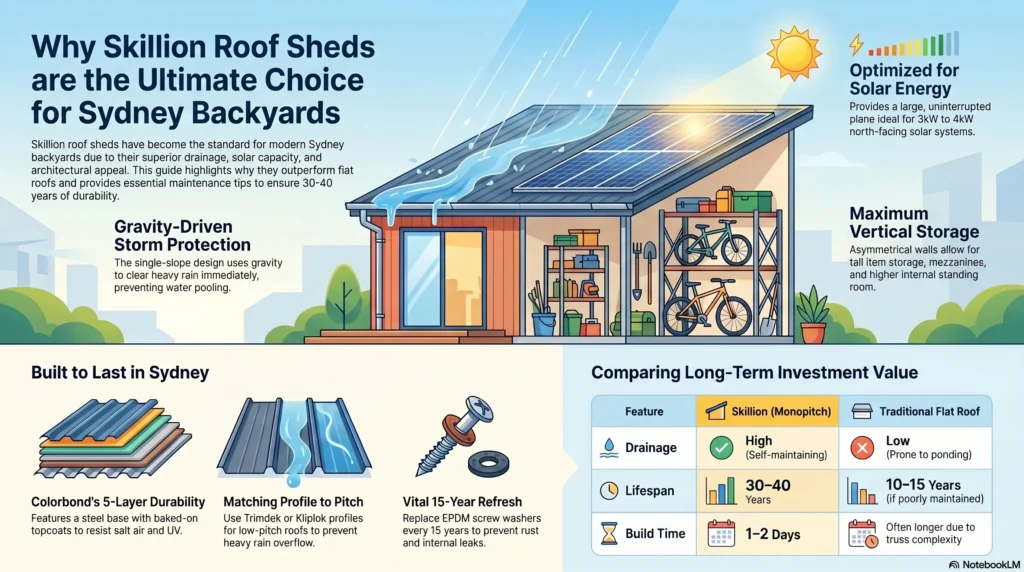
It’s no wonder that the skillion roof shed (monopitch roof) is the preferred choice for everyone building new. One slope, clean lines, it’s not against the flow of Sydney weather. Before you choose a design, here what you need to know about roofing solutions in Sydney.
What’s a Skillion Roof Shed?
It’s not a big hill. One side has a high wall, the other a low wall. No ridge, no valley. The high side is typically opposite your house or garage, and the low side is towards the yard.
When you look at council plans or engineering drawings, it will be referred to as the word “monopitch.” However, all Sydney builders and shed suppliers refer to it as a “skillion”. It’s just a matter of whom you’re talking to.
And the pitch? That matters. The steeper the slope the better it will manage rain and provide headroom inside. However, councils have height restrictions and your neighbours? Well, they have opinions too. A lower profile on the slope reduces the slope angle but still moves the water.
Why Sydney Homeowners Actually Choose These
1. The Rain Doesn’t Pool
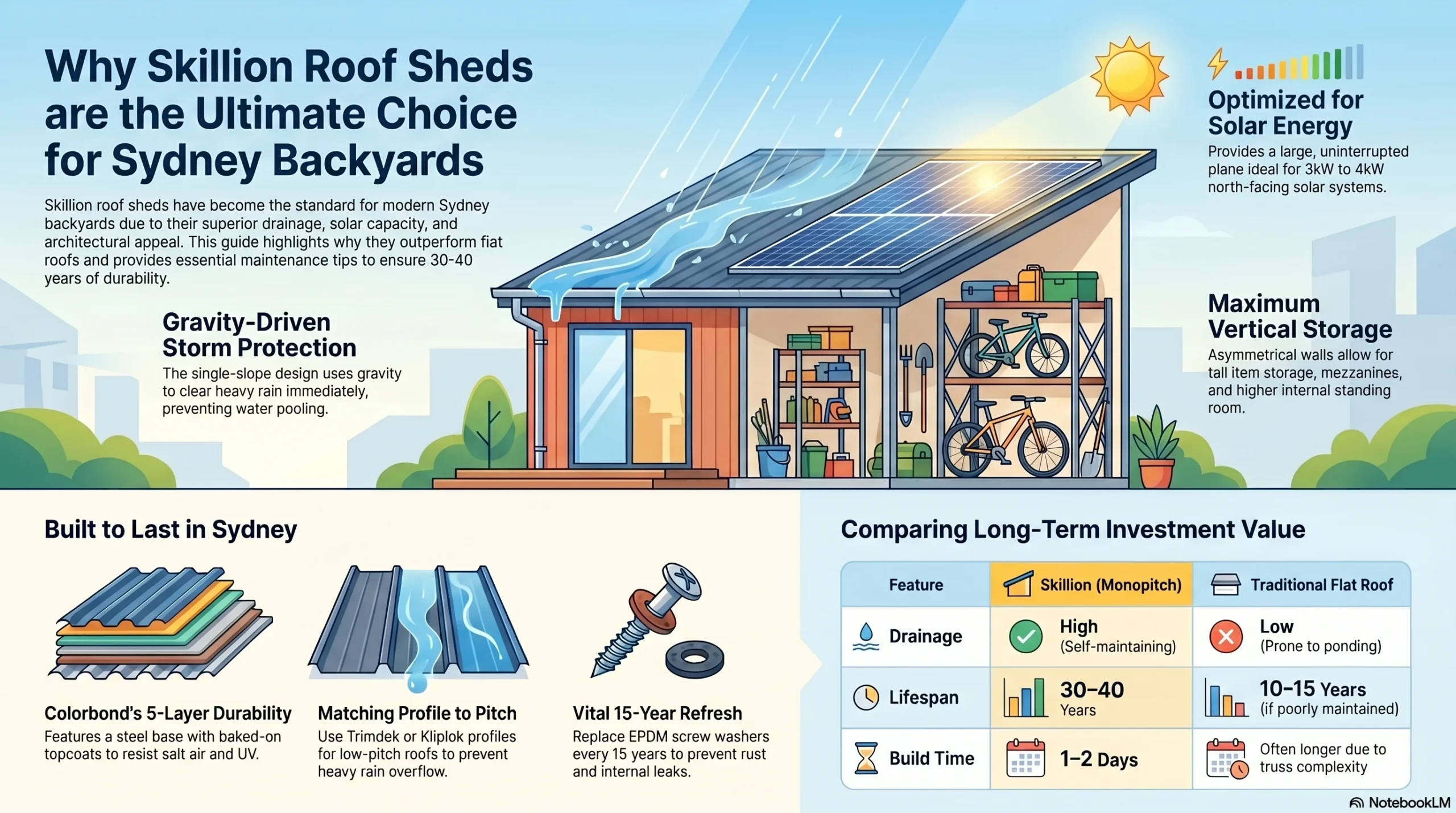
Sydney storms don’t mess around. When the sky opens up over the Northern Beaches or the Sutherland Shire, water needs to clear the roof immediately. A skillion roof sends it all in one direction — straight to the gutter and down the downpipe.
Flat roofs rely on perfect falls to hidden drains. One blocked outlet, one slight dip in the deck, and you’ve got a pond on your roof. Once water sits, it finds a way in. A skillion roof uses gravity. It’s simpler and more forgiving.
2. Solar Actually Works
Energy bills being what they are, people are putting panels anywhere they can. A skillion roof gives you one uninterrupted plane facing the same direction. No ridges to work around, no multiple aspects throwing shadows.
Face the roof north and you’ve got room for a 3kW or 4kW system. Enough to run lights, tools, even a split-system aircon in your backyard office. The shed earns its keep instead of sitting idle.
3. It Looks Like You Planned It
There’s a reason architects use skillion roofs on contemporary extensions. The asymmetry looks intentional. In a backyard, that matters — especially if your shed is visible from the outdoor kitchen or the pool.
For a terrace in the inner west or a new build out in the Hills District, a skillion roof shed matches the house instead of looking like an afterthought. Clean lines, one material, done properly.
4. You Get Usable Height Inside
Because one wall is taller, you can actually stand up straight on that side. Store long items vertically. Hang bikes from the tall wall. Put in a mezzanine for timber or camping gear. A flat roof gives you the same cramped headroom everywhere. A skillion roof gives you options.
Cheaper and Faster to Build
No ridge cap. No complex trusses. Fewer cuts, fewer joins, less labour. For a standard backyard job, that translates to a lower quote and the builders finishing in a day or two instead of a week.
Colorbond: The Only Real Choice for Sydney
When it comes to metal shed roofing in this city, Colorbond isn’t just popular — it’s what every decent builder will quote you. Made by BlueScope, tested here for over fifty years, and designed for exactly the conditions we get.
Why It Actually Lasts
Colorbond isn’t painted steel. It’s five layers: steel base, metallic coating for corrosion resistance, pretreatment, primer, and a baked-on topcoat. That’s why it doesn’t chip like paint and why surface rust isn’t the constant battle it is with cheaper imports.
If you’re anywhere near the coast — Manly, Cronulla, the Central Coast — salt air eats roofing alive. Colorbond Ultra is specifically made for those conditions. Inland, you’ve got UV that’ll bleach and crack lesser materials. Colorbond handles both without needing a repaint every few years.
The Thermal Side
Colorbond’s Thermatech reflects more heat than standard roofing. In a Sydney summer, that keeps the shed cooler and stops it from radiating heat back at your house. In winter, it helps retain warmth. Over years, that efficiency shows up.
Colours That Actually Work
Twenty-plus standard colours. Monument and Woodland Grey for modern builds. Surfmist if you want it to disappear against a light-coloured house. Basalt for something in between. Match the shed to your fence, garage door, or house trim so the backyard looks planned, not patched together.
Fixing Leaks: What Actually Goes Wrong
Even a good shed leaks if the details are wrong. Here’s what fails and how to fix it without just slapping more silicone on top.
Wrong Profile for the Pitch
This is the classic mistake. Standard corrugated iron on a low pitch is a mistake. In heavy rain, water fills the valleys and spills over the side laps. Right into the roof cavity.
Fix: If you’re building or replacing, use Trimdek or Kliplok — profiles engineered for low pitches. If you’ve already got corrugated iron on a shallow slope, patches won’t save you. Re-roof with the right profile or accept that it’ll leak every time Sydney gets a real storm.
Perished Screw Washers
A roofing screw must have rubber washers that, after 10 or 15 years become impossible to move. Rubber washers on roofing screws become hard and crack after 10 or 15 years. When the washer is removed the screw hole is an open conduit for water. Rust will be visible on the screws’ heads, extending down the screw.
Fix: Replace all the roofing screws with new ones, same colour as the original; and replace all the EPDM washers. If the hole has been worn out, move one level up in screw size or add a load spreading washer below the screw. Apply an approved primer to exposed bare steel immediately – the moment rust begins it spreads quickly.
Blocked Gutters
Gum trees and jacarandas lose their leaves all year round in Sydney. The blocked gutter drips over at the bottom of the skillion roof and water also collects under the edge of the skillion roof and into the lining of the walls.
Fix: Clean gutters regularly, 4 times per year. Consider putting on gutter guards if you have trees near you. Make sure downpipes are clear and discharge well away from the slab. The water can collect at the base and will wick up through the bottom plate/wall-base seam and cause the bottom plate to rot.
Sagging Sheets
If the purlins were undersized or someone’s been walking on the roof, sheets sag. Water ponds in the low spot. Ponding leads to leaks, and leaks lead to structural damage.
Fix: This is structural. Get a builder or roofer to check purlin spacing and sheet thickness. Sometimes a mid-span support fixes it. Often the roof needs to come off and be rebuilt with adequate framing. Don’t ignore it — a sagging roof only gets worse.
Skillion vs Flat Roof: The Honest Comparison
Flat roofs have their place. They’re compact, work against boundaries, and can be cheaper for a tiny footprint. But they come with baggage.
Flat roofs need perfectly level construction and carefully designed falls to drainage points. Any error, and you’ve got ponding. They also trap leaves because there’s no slope to encourage debris to slide off.
A skillion roof avoids most of that by design. The slope is obvious and self-maintaining. Water and leaves move in one direction. Ventilation is simpler if you’re storing fuels or chemicals. And it looks deliberate, not apologetic.
For sydney roof conditions and typical backyard sizes, the skillion roof is usually the smarter long-term buy.
FAQ: What Sydney Homeowners Actually Ask
How much does it cost to install a skillion roof shed in Sydney?
Charges depends upon the variable factors which includes backyard size, dimensions and color of your choice. Charges can be in between 8000to20,000. For expert roof replacement Sydney pricing, always get three local quotes.
Is it possible to install solar panels on a skillion roofed shed?
Yes. Installation is simple because all of the parts are flat. If you live in an exposed area, be sure the framing is rated for the additional weight and wind load.
What is the lowest pitched shed?
The average requirement for Colorbond is 5 degrees or more. For areas with high rainfall in Sydney or over longer distances, the steeper the better. If the number is too low and the same profile, you will leak.
A skillion roof shed is a monopitch roof shed?
Yes. The builder/supplier calls it “skillion. On plans and permits it is called “monopitch.
How long will a Colorbond skillion roof last?
Then 30 to 40 years of proper installation and simple Sydney roofing maintenance (gutter cleaning, checking screws, picking up scratches) and they should last you. It is reflected in BlueScope’s warranties.
Council approval for skillion roof shed Sydney?
Typically yes, but for smaller structures there is exempt development under the NSW Housing Code. The height limits, boundary setbacks and site coverage vary between councils. Stop and check before committing!
Why is my flat roof shed leaking but my neighbours skillion roof shed is not leaking?
The integrity of the membranes and the perfect drainage are essential for flat roofs. Water’s in one outlet and a split seam! The primary line of defence in a skillion roof is gravity. More tolerant, more easy to take care of.
Can I convert a flat roof shed to a skillion roof?
Sometimes, but it often means replacing the entire roof structure and possibly the walls if they’re not height-matched. Usually cheaper to replace the whole shed if it’s over ten years old.
What Colorbond colour should I choose?
Lighter colours like Surfmist or Classic Cream reflect more heat — good if the shed sits close to your house. Darker colours like Monument or Basalt look sharp against greenery but run hotter inside. Match your existing palette.
Are skillion roof sheds noisy in the rain?
All metal roofs make noise. The pitch of a skillion roof helps — water runs off rather than drumming on a flat surface. Ceiling insulation or an anti-condensation blanket underneath reduces sound and stops drips from temperature differences.
How do I stop my skillion roof shed from leaking?
Use the right steel profile for your pitch. Keep gutters clear. Replace perished screw washers before they fail. Check flashing where the roof meets your house annually. Don’t ignore small rust spots — they spread fast in coastal air.
Final Word
A skillion roof shed isn’t a trend. It’s a practical response to Sydney’s weather, energy costs, and the fact that people actually use their backyards now. Built with Colorbond and detailed properly, it’ll outlast cheaper flat-roof alternatives and give you usable space — for storage, solar, or a workshop — instead of a headache.
Get the pitch right. Use the correct steel profile for that pitch. Don’t cut corners on flashing and gutters. The extra care during construction saves you from the familiar roofing solutions in Sydney story of chasing leaks every time a storm rolls in from the east.