Colorbond Roof Colours for Sydney Homes: A Heat, Coastal and Council Guide
Listen to the minisode.
If you’ve settled on a metal roof, the next decision is harder than it looks. You’re standing in front of a Colorbond swatch card wondering which shade will actually suit your house, cope with a Sydney summer, and still look right in fifteen years. This is the sort of choice that sits on your roof for decades, so it’s worth getting right the first time. Colour affects more than kerb appeal too — it plays into how hot your ceiling space gets in January and how well your roof stands up to salt air or bushfire conditions, depending on where in Sydney you live. This guide walks through Colorbond roof colours Sydney homeowners actually choose, and why, so you can shortlist with confidence before your re-roofing Sydney job goes ahead.
What Colorbond Actually Is
This guide is about colour selection for a full re-roof. If you’re after roof colorbond repair Sydney work instead — patching a section of storm damage, say — the priority is usually matching the existing sheeting rather than picking something new, so a lot of what follows won’t apply in the same way.
Colorbond starts as steel, then gets built up in layers. First, a metallic coating goes on for corrosion resistance, then a paint finish gets baked on at high heat for colour and UV protection. That baking process happens before the sheet is even profiled, which is the real reason Colorbond holds its colour so much longer than something painted on site after the fact.
Not all Colorbond is the same, though — there are three grades, and each one is solving a different problem. Standard is what most Sydney homeowners end up with, and it does the job fine for most inland properties. If you’re closer to the coast, Colorbond Ultra is the one to look at — it carries a heavier metallic coating built to cope with salt air, which will eat into standard steel over time. Then there’s Matt, which isn’t really about protection at all — it’s a low-sheen finish that’s become popular on newer homes because it looks understated rather than shiny, and it’s more forgiving of small surface marks than a gloss finish is.
We’ll come back to when Ultra is worth the extra cost. For now, the main point is this: colour choice and grade choice are two separate decisions, and conflating them is the most common mistake we see. A homeowner can pick any colour in the range and still choose standard, Ultra or Matt underneath it — the colour itself doesn’t lock you into a grade.
If your home is still carrying an old fibro or corrugated cement roof, asbestos roof removal usually comes first, before any Colorbond sheeting goes on. It’s worth factoring into your timeline and budget early, since it’s a separate, licensed job from the re-roof itself, and it needs to be completed and signed off before new sheeting can be installed. Most Colorbond roof installers Sydney-wide can coordinate this as part of the overall project, so it doesn’t have to mean juggling two separate trades yourself.
Heat Is the Sydney Question
This is the section that actually matters, because in Sydney, roof colour affects how hot your house gets — not just how it looks from the street.
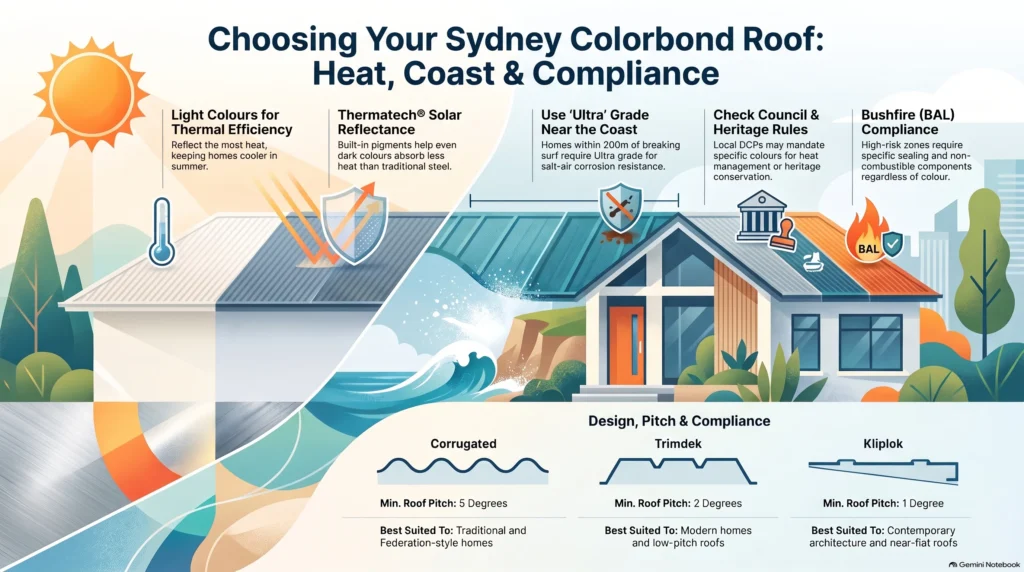
This is where Colorbond’s Thermatech technology comes in — it’s a solar-reflective pigment built into every colour in the range, and it means even dark tones absorb less heat than older-generation steel roofing did. It’s a real step up from the plain painted steel roofs from a generation ago, and it’s usually the bit people are surprised by once they understand what’s actually going on under the colour.
That said, the physics doesn’t disappear entirely. Light colours like Surfmist, Dune, Shale Grey and Evening Haze reflect the most heat and stay noticeably cooler to the touch on a 35-degree day. Dark colours — Monument, Basalt, Night Sky — still run warmer than light ones even with Thermatech doing its job, because dark pigments absorb more visible light by nature. No coating technology changes that basic physical property.
For a single-storey home in western Sydney with a north-facing roof and limited insulation, this isn’t a minor aesthetic footnote — it’s a genuine comfort and running-cost decision. If you’re set on Monument or Basalt for the look, that’s a reasonable trade-off to make with your eyes open. Just budget for it in your cooling costs, and make sure your insulation and roof ventilation are doing their share of the work too.
Coastal Versus Inland: Does It Change Your Colour Choice?
Salt-laden air corrodes steel faster than inland air, full stop. That’s why Colorbond Ultra exists — it’s built for homes within a certain distance of breaking surf, where standard-grade steel would show premature corrosion at exposed edges and fixings, sometimes within just a few years of installation.
BlueScope specifies Ultra for homes roughly 100 to 200 metres from breaking surf, so if you’re in Bondi, Coogee, Bronte, Manly or Cronulla, it’s worth a proper conversation with your roofer rather than an assumption either way. Wind direction, elevation and how exposed your specific block is to sea spray all factor into the actual risk, which is why a blanket rule from a swatch card or a website rarely matches what’s happening on your particular roof. Homes further inland — the Hills District, the inner west, most of western Sydney — generally do fine on standard grade.
The good news is that grade doesn’t restrict your colour choice. Ultra is available across the same colour range, so a coastal home doesn’t have to compromise on the look it wants in order to get the corrosion protection it needs. As a rule, any time we’re installing Colorbond near saltwater, we specify Ultra as standard — it’s built to resist the kind of corrosion that regular steel simply isn’t designed to handle.
Bushfire Zones: BAL Ratings and What They Mean for Your Roof
If your property sits in the Blue Mountains, Hornsby’s bushland fringe, or parts of the Sutherland Shire, your roof isn’t just a style decision — it’s a compliance one. Bushfire Attack Level (BAL) ratings under Australian Standard AS 3959 set out construction requirements based on your property’s bushfire exposure, and roofing is one of the areas assessed as part of that rating.
Colour itself doesn’t change your BAL compliance, but the detailing does. As the BAL rating climbs, AS 3959 asks for more: fully sarked roofs with no gaps at fascias, valleys or ridges, non-combustible gutters, and ember guards with fine mesh over any roof penetration or vent. At the highest rating, BAL-FZ, every roof material has to be non-combustible and every opening sealed. If you’re building or re-roofing in a mapped bushfire zone, get your BAL rating confirmed before you lock in materials — it can affect which sarking and roof penetration products are even available to use.
Profiles, Not Just Colours
Colour gets most of the attention, but the profile — the physical shape of the sheet — affects cost, pitch suitability and appearance just as much, and it’s worth deciding on first.
| Profile | Appearance | Minimum roof pitch | Typical cost | Best suited to |
| Corrugated | Classic wave pattern | Around 5 degrees | Most affordable | Traditional and Federation-style homes |
| Trimdek | Bold, structured ribs | Around 2 degrees | Mid-range | Modern homes, sheds, low-pitch roofs |
| Kliplok | Concealed fixings, clean lines | Around 1 degree | Higher | Contemporary architecture, near-flat roofs |
| Spandek | Similar to Trimdek, slightly different rib spacing | Around 3 degrees | Mid-range | General residential re-roofs |
These figures are general guidance — always confirm the exact minimum for your chosen sheet length and manufacturer before finalising a profile.
If your roof has a low pitch, this table narrows your options before colour even comes into it — Kliplok and Trimdek suit low-pitch roofs where Corrugated may not perform as well against water pooling. It’s a practical constraint worth checking early, because a colour you’ve fallen for might only be available on a profile your roof pitch can’t actually use.
Popular Colour Choices in Sydney
When homeowners come to us partway through a Colorbond roof replacement, they’ve usually already narrowed things down to two or three shades. Some colours turn up again and again in those shortlists, and it’s not random — here’s what we see chosen most across Colorbond roof colours Sydney homes, and why it tends to work.
| Colour | Common on | Heat performance | Why homeowners choose it |
| Monument | Contemporary builds, renovations | Runs warmer, needs good insulation | Strong, modern street presence |
| Basalt | Contemporary and industrial-style homes | Runs warmer | Softer than Monument, still dark and current |
| Surfmist | Coastal homes, weatherboard cottages | Cool-running | Classic, versatile, resells well |
| Dune | Coastal and Hamptons-style homes | Cool-running | Warmer white tone than Surfmist |
| Windspray | Brick homes, all-rounder | Moderate | Neutral grey that suits most brickwork |
| Wallaby | Federation and older homes | Moderate | Earthy tone that complements terracotta and sandstone |
There’s no single “correct” answer here — it comes down to your house style, your street, and how much weight you put on heat performance versus the look you’re after. We’d rather talk you through the trade-offs honestly than push whichever colour happens to be trending that season.
Heritage and Council Restrictions
If you’re in a heritage conservation area — parts of the inner west and older north shore suburbs are the ones we see most often — your council’s Development Control Plan may restrict roof colour, sheen, or profile. Some councils require a heritage-appropriate palette or ban high-gloss finishes outright, and a handful go as far as specifying an approved colour list.
It’s not only heritage areas pulling in this direction, either. Some newer growth-area councils are going the opposite way, mandating light or white roof colours on new builds specifically to manage heat load across the suburb. We’ve done work in Menangle Park, for example, where council requirements call for white roofing on new homes.
We’re not going to guess at specific council rules here, because they vary street by street and change over time. The one piece of advice that holds everywhere: check your local council’s DCP, or ask whether your property carries a heritage overlay or a heat-management requirement, before you order materials. It’s a much cheaper phone call than a rejected colour after installation, and it can save weeks of delay if your original choice needs council sign-off.
Matching Gutters, Fascia and Downpipes
Guttering and fascia come in the same Colorbond colour range as your roof sheeting, which opens up two real design paths. Matching everything to the roof colour gives a clean, unified look from the street, which is the safer option if you’re not confident mixing tones. Contrasting the fascia or gutters against the roof — a dark roof with light fascia, for instance — can add definition and make the roofline stand out, and it’s a look we’re seeing more of on newer builds.
Either approach is legitimate. What matters is deciding on purpose rather than by accident, and getting matching guttering and fascia ordered and installed as part of the same project so colours and finishes line up properly, rather than trying to match an existing gutter to a new roof colour after the fact.
Cost and Warranty
Colour choice generally doesn’t move the price of your roof — a Monument roof and a Surfmist roof in the same profile and grade cost roughly the same, since the pigment itself isn’t the cost driver. What does affect price is grade and finish: Colorbond Ultra and the Matt finish both carry a premium over standard gloss, and that premium is worth weighing against your specific exposure to salt air rather than applied as a blanket rule.
Pricing for a Colorbond roof replacement Sydney job depends on whether you’re stripping off an old roof or starting fresh. A full strip-off and installation of new Colorbond sheeting runs $180 to $250 per square metre. Supply and install on a new build, with no old roof to remove, drops to $100 to $160 per square metre. Either way, the final figure depends on profile, pitch complexity and site access.
On top of the material itself, Colorbond carries a BlueScope manufacturer warranty, running up to 36 years against corrosion perforation and up to 20 years on paint performance, depending on distance from the coast, roof pitch and application. We back our own work with a 5-year workmanship warranty on top of that, so you’re covered on both the material and the installation. Ask for the warranty specifics in writing before you sign off on a colour and grade.
Frequently Asked Questions
What is the best Colorbond colour for a hot Sydney summer?
Stick with something light — Surfmist, Dune and Shale Grey are the standouts for staying cool underfoot and keeping heat out of the roof space. Thermatech helps every colour perform better than older steel, but on a proper 35-degree day, light still beats dark.
Does a dark Colorbond roof make the house hotter?
A little, yes. Thermatech takes the edge off how much heat colours like Monument or Basalt soak up compared to old-style steel, but dark will always run warmer than light; if you’re going dark, lean on good insulation and ventilation to make up the difference.
Do I need Colorbond Ultra in Sydney?
Depends on how close you live to the water. If you’re near breaking surf in the eastern suburbs or northern beaches, Ultra’s extra corrosion protection is usually the right call. Further inland, standard grade holds up fine — worth getting your roofer to check your actual site, though.
Can I change colour when I re-roof?
Absolutely — re-roofing is the easiest time to switch things up, since the old sheeting’s coming off anyway. Just double-check you’re not in a heritage conservation area first, as some of those come with colour restrictions attached.
How long does a Colorbond roof last in Sydney?
There’s no single number here — BlueScope’s warranty covers up to 36 years against corrosion, but what you actually get depends on the grade you choose, how close you are to the coast, and whether the roof’s been properly maintained. If you’re near saltwater, Ultra is what keeps that lifespan intact rather than watching it shrink.
Can I get gutters in the same colour?
Yes — guttering and fascia are made in the same colour range as the roof sheeting itself, so you can match everything up or go for a deliberate contrast, whichever look you’re after.
Do I need council approval to change roof colour?
Sometimes, yes. A standard re-roof in a similar colour usually sails through, but heritage areas and some council DCPs get strict about colour and finish. On the flip side, a few newer growth suburbs now require light or white roofs to help manage heat — so it pays to check either way before you order.
Ready to Choose Your Colour?
Swatch cards look different under office lighting than they do on your actual roof, in your actual street, against your actual brickwork. The best way to choose is to see the options on site, where the light and your surroundings can be properly assessed. That’s the kind of on-site advice professional roofing services Sydney homeowners rely on, rather than guessing from a swatch card at home.
Getting your Colorbond roof colours Sydney shortlist right the first time saves you from a costly reorder later, and from living with a colour that doesn’t quite work once it’s actually up on the roof. We handle Colorbond roof replacement nsw wide, from coastal suburbs through to the foothills, so wherever you’re located, book a free consultation and we’ll talk you through colour, grade and profile for your specific home.