Emergency Roof Repairs Sydney: How to handle Storm Damage and Leaks Fast
Listen to the minisode.
When the Storm Hits: What to Actually Do About a Leaking Roof
It all changes at some point in time in a crazy storm in Sydney. You hear the rain being poured down, you wish that the roof could support the weight, and you are looking at a black spot that gradually grows larger on the roof. It is the type of fear that leaves you standing there. Water is in your house, and the what-ifs begin to mount up. Will the ceiling cave in? Is there water near the wiring? How bad is this going to get? The point is, it is not necessary to be a builder to cope with the first hour. You only have to remain cool and do some clever things. This is what I have come to know after reading through it.
Why Roofs Spring Leaks During Storms (It’s Not Always What You Think)
Here’s something that surprised us: your roof doesn’t necessarily fail because the storm smashed it. Often, it fails because it is already tired.
Think about what a Sydney roof goes through. Months of intense heat dry everything out, and materials shrink and shift. Then suddenly you’ve got freezing rain and howling winds. It is an enormous jolt to the system. Tiles rise up, seals that were already fragile crumble away, and water is able to creep through places you never even thought were there.
What makes it worse is that during a storm, rain doesn’t just fall straight down. Wind drives it sideways, even upwards. It gets forced under tiles, behind flashing, into every tiny weak spot. So even if your roof looks fine from the street, it might be struggling. This is exactly when professional emergency roof repairs in Sydney become necessary.
The First Hour: What Really Works
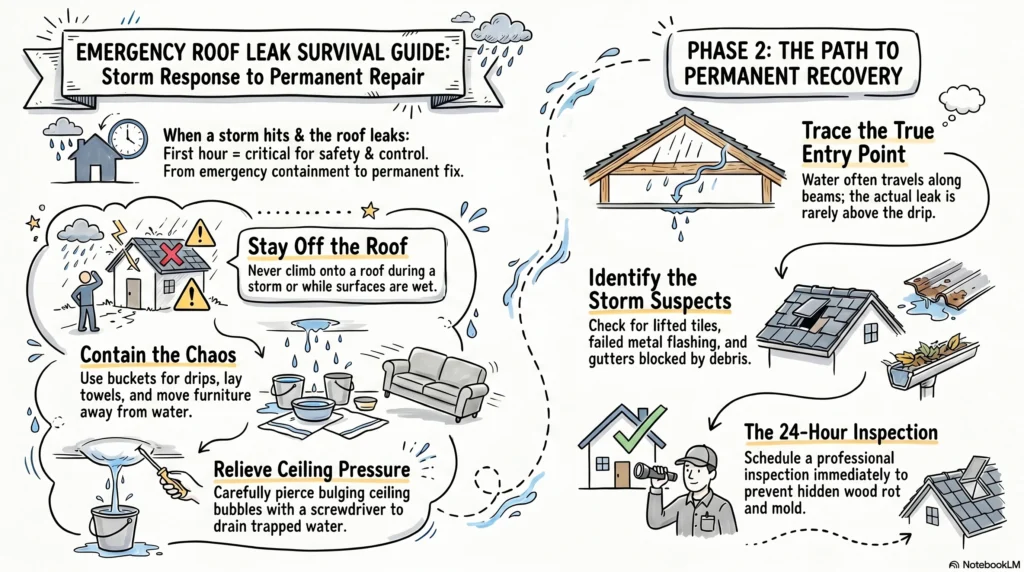
There is one thing that should be made plain: do not go on that roof. Not in the storm, not in the wind, not when it is wet. It’s not brave, it’s dangerous. Stay on the ground.
What you can do is to contain the mess.
Take buckets, pots, plastic containers, whatever can hold water, and get all of them under all the drips. In case the water is splashing on the floors, lay towels to make things slow down. Clear out furniture and valuable items in the room. Water is fond of running down beams and then dripping, and thus the leak may fall three feet away, where the water is not getting in.
Once the ceiling starts to bulge or bubble, it is a sign that there is some water that is pooling above. It is so terrible to the eye, but you can stab the bottommost of the bubbles with a screwdriver, and then hold a bucket underneath and make the water run away.
And do, by any chance, that there is water anywhere close to the light fittings or power outlets, switch off the switch at the circuit board. Don’t risk it.
One more thing — take photos. We appreciate the fact that the last thing on your mind is to take your phone and take some pictures of the day. It aids in ensuring the future, and it will give tradies a better concept of what they are getting into.
The Sticky Bit: Locating the Real Entry Point
Everyone is made mad by this part. The drip of water that you see dripping into your lounge room may not be the drip of the water that is dripping off the roof above. The water becomes able to slide along the rafters, across the beams, and it only drips down the ceiling once they have a low point. The real spillage might be metres distant – around a chimney, a skylight or a valley join.
This is why keeping things confidential on the inside is hardly ever effective. It would prevent the drip at present, but up there, the timber and insulation would remain wet, and that is where mould and rot begin.
What Usually Breaks in a Storm
From what I’ve seen and heard, these are the usual suspects:
Lifted tiles
Wind gets underneath, lifts them slightly, and breaks the seal. The tile often settles back down afterwards, so everything looks fine from below — but the damage is already done.
Hail damage
It doesn’t always smash tiles. Sometimes it just creates tiny stress fractures that grow over time. The leak might not show up until the next downpour.
Flashing failures
The metal around chimneys and skylights expands and contracts constantly. A storm can be the final push that pulls it away from the seal.
Blocked gutters
Honestly, this one’s more common than people realise. When gutters are full of leaves, water overflows and can push back under the roof edge.
Temporary Fix vs Permanent Fixes
During a storm, emergency roof repairs are about stopping more water from getting in — throwing a tarp over the affected area, popping a tile back, sealing an exposed gap. It’s a Band-Aid, and that’s fine for the moment. However, when it gets clear, you need the one who actually does it. A lasting solution addresses the cause – the broken tile is substituted, the flashing is installed correctly, and the waterproof membrane beneath is repaired. Otherwise, the issue is only waiting till the next storm happens again. For lasting peace of mind, always follow up with professional roof repairs in Sydney to ensure the job is done right.
The Day After
The rain subsides, the sun appears, and the drops cease to drip. It is alluring to proceed and get it out of mind. But it is at this point that a lot of rot begins. Wet insulation stores moisture for days. Timber can warp slowly. And in Sydney, the dampness it gets, mould will spread quicker than you think. When you do smell musty the following day or two, then it is moisture that is in the wrong place. It is big to get a person up to have a look in 24 hours. It desiccates things in the right way and prevents minor problems from becoming major.
Why Waiting Costs.
Nevertheless, as the water grows to the ceilings, insulation and walls, the work increases exponentially. You are not fixing the roof; you are putting in plaster, taking out damp insulation, repainting, and even treating mould. A minor restoration becomes a very expensive restoration.
Having roof replacement solutions will be beneficial in case the damage is not minor, as the house will require frequent repairs.
A Bit of Prevention Goes a Long Way
After the repairs are done, a little roof maintenance stops you from ending up here again. Clearing gutters before storm season, keeping an eye out for cracked tiles, and having someone check the flashing every now and then — it’s simple stuff that makes a real difference.
Roofs rarely fail completely without warning. The warnings are just easy to miss when you’re busy with everything else.
When to Call for Help
When water is pouring actively, when the ceiling is sagging or when you are concerned about electrical safety, call somebody at once. It is where emergency roof repairs come in. In case the storm had already gone by, and you only now realise that there are some stains, some damp smell, or some tiles that were dislodged, you want to set up an inspection within one day or so. or so. It’s worth the peace of mind.
A roof that is leaking in the rain is really stressful. But you can handle it. Safety should be the first priority, contain the water, and do not take chances. Water does not go as far as you think it can, and what you actually see as a leak is often not the actual entry point. A good tradie will not only cover up the symptom, but he or she will work back to correct the problem.
When the roof is letting in water, it should be an emergency. Quick reaction saves your house and spares you from much stress in the long run. You’ve got this. Get in touch for roofing services in Sydney.