Roof Restoration Sydney: Repointing, Rebedding or Full Replacement?
Listen to the minisode.
Two roofers, same roof, wildly different numbers — one says $4,000 to restore it, the other says $18,000 to replace it outright. Both talk like they’re certain. Neither one tells you why they landed on that figure, which leaves you stuck in the middle wondering if you’re about to get ripped off, or about to underspend on a roof that actually needs the bigger job done properly. Not a great feeling when it’s the thing keeping the rain off your family. So let’s actually sort that out — what roof restoration Sydney homeowners need to know before signing anything, and exactly where roof maintenance Sydney leaves off and restoration takes over.
What Roof Restoration Actually Includes
“Restoration” gets used loosely in this industry, which is part of the problem. Some companies use it to mean a simple roof clean. Others use it for a full ridge rebed and reseal. When two quotes use the same word for two different scopes of work, of course the prices look wildly inconsistent — they’re not actually quoting the same job.
It’s also worth being clear on what restoration isn’t. If you’re only dealing with a single leak, a broken tile, or a damaged section after a storm, that’s usually roof repairs Sydney territory — a smaller, targeted job rather than the full process below. Restoration is the right call when the roof’s overall condition needs addressing, not just one isolated problem.
Real restoration isn’t just a rinse and a coat of sealant slapped on top — there’s an actual process to it. It starts with a proper inspection, then a clean (pressure or soft wash, depending on how the tiles are holding up), any broken tiles get swapped out, the ridge capping gets rebedded and repointed where needed, and it finishes with a sealing or membrane coat over the top. Skipping any one of these steps to hit a lower price isn’t really a restoration — it’s a partial job wearing a restoration price tag. If a quote comes in well below others you’ve received, ask specifically which of these steps are included and which aren’t.
Repointing Versus Rebedding
This is the distinction that actually explains most of the price gap between quotes, and it’s worth understanding properly.
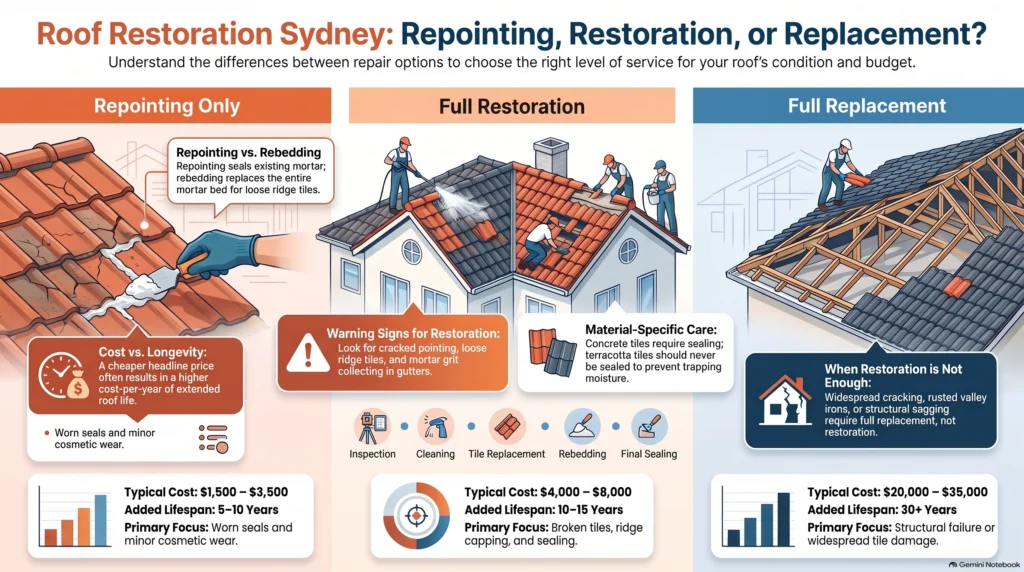
Bedding is the mortar bed that your ridge tiles physically sit on and are held down by. Pointing is the flexible compound applied over the top of that mortar, sealing the joint against weather. Rebedding is the bigger job — the ridge tiles come off, the old mortar gets chipped out, and a fresh bed goes down before the tiles are put back. Repointing is more contained. The mortar bed stays as it is, and only the flexible pointing layer on top gets renewed.
| What it involves | When it’s needed | Relative cost | |
| Repointing only | Renewing the flexible seal over existing mortar | Pointing has cracked or worn but the mortar bed underneath is still sound | Lower |
| Rebedding | Removing ridge tiles, replacing the mortar bed entirely | Mortar has crumbled, ridge tiles move underfoot, or repointing has already been done once and failed again | Higher |
Rebedding costs more because it’s genuinely more labour — pulling tiles off, cleaning them, mixing and laying new mortar, then repointing on top regardless. A roofer who tells you rebedding is needed everywhere the pointing looks tired isn’t necessarily wrong, but it’s worth asking them to show you which sections actually need it versus which just need repointing.
In practice, most Sydney tile roofs don’t need one treatment applied uniformly across the whole ridge line. It’s common for the sections facing prevailing weather — usually the western and southern exposures — to have failed mortar while the more sheltered sections are still sound. A thorough assessment should tell you which is which section by section, rather than quoting a blanket rebed across the entire roof when only part of it actually needs it.
Warning Signs You Need Roof Restoration
These are the signs your roof needs restoration rather than just a routine clean, and they’re worth checking for at least once a year, particularly after a rough storm season.
- Cracked or missing pointing along the ridge line
- Ridge tiles that shift or feel loose when walked near
- Mortar debris or sandy grit collecting in your gutters
- A handful of isolated cracked or slipped tiles
- Moss or lichen building up on the southern roof face, where sun exposure is lowest.
- A faded, chalky tile surface that’s lost its original colour depth
None of these individually mean disaster. But two or three showing up together is usually the point where it’s worth booking a restoration before an isolated issue becomes an actual leak. If you’re already up there checking, it’s a good time to clean your gutters and downpipes as well, since ridge mortar debris tends to collect exactly where water needs to flow freely.
When Restoration Is Not Enough
Restoration only works if the roof structure and tiles underneath are fundamentally sound. Sometimes they’re not, and being honest about that upfront saves you money in the long run — there’s no point paying for a nice new seal over a roof that’s going to need pulling apart again in three years.
There are a few signs restoration won’t be enough on its own: tile cracking spread across several roof planes rather than a few isolated spots, sarking that’s failed underneath, valley irons that have rusted through or gone perforated, or any sagging in the roof structure itself. And if the roof’s already been restored once and the same issues have come back, that’s not usually a sign the earlier work was done badly — it’s more a sign the tiles or structure have simply reached the end of their life.
One more thing worth flagging on its own: if your home’s got an older cement or fibro roof rather than terracotta or concrete tiles, that’s a different situation entirely. You can’t just pressure-wash or drill into that material the way you would with standard tiles — asbestos roof restoration has to be assessed and handled by a licensed professional before anyone touches it. In any of these cases, you’re genuinely better off going straight to a full roof replacement rather than paying for a restoration on a roof that’s only going to need replacing again in a few years regardless.
Terracotta Versus Concrete Tiles
These two materials behave differently under restoration, and treating them the same is a common way jobs go wrong.
Terracotta tiles are fired and glazed, which means they’re naturally weather-resistant on their own — sealing a terracotta roof can trap moisture underneath the glaze rather than protecting it, and generally isn’t recommended. Concrete tiles are porous by comparison, and they do benefit from a proper sealing coat, which restores colour and adds a genuine layer of weather protection. Getting this backwards — sealing terracotta or leaving concrete unsealed — is a mistake that costs more to fix later than it would have to do the first time correctly.
It’s also worth knowing which one you actually have before you get quotes, since it changes what a fair scope of work looks like. Concrete tiles tend to fade to a chalky, faded finish as they age, which is exactly the kind of tile that benefits most from a colour-restoring seal. Terracotta ages differently — it can pick up moss and staining, but the underlying glaze usually still does its job, so cleaning and repointing matter more than any coating.
The Pressure-Cleaning Risk
This is where an inexperienced or rushed operator can do real damage, and it’s worth knowing what to look out for before you hire anyone.
Old or brittle tiles, particularly on a roof that hasn’t been touched in fifteen-plus years, can crack under aggressive high-pressure cleaning. Worse, forcing water at high pressure under the tile line can push moisture past the tiles and into the sarking below, creating a leak that didn’t exist before the “clean” started. What looks like an aggressive, thorough clean on the day can actually be the reason you’re calling a roofer back out six months later for a leak that has nothing to do with the original problem.
A careful operator adjusts pressure to the tile condition, works methodically rather than blasting for speed, and checks for cracked tiles as they go rather than powering straight through. If a quote sounds unusually cheap and unusually fast, this is often where corners are being cut — a rushed clean on a large roof is one of the more common ways a restoration ends up causing more damage than it fixes.
Cost Comparison: Repointing, Restoration and Replacement
Headline price only tells you part of the story — what actually matters is cost per year of extended roof life. A cheaper job that only buys you five extra years can end up costing more per year than a pricier one that buys fifteen. Here’s how the three options generally compare on a typical Sydney single-storey tile roof.
| Option | Typical cost | Added lifespan | What it addresses |
| Repointing only (with minor rebedding) | $1,500–$3,500 | Around 5–10 years, provided the tiles, battens, sarking and roof structure are otherwise sound | Worn pointing, minor cosmetic wear |
| Full restoration | $4,000–$8,000 | Around 10–15 years | Broken tiles, ridge capping, sealing, overall condition |
| Full replacement | $20,000–$35,000 | 30+ years, depending on material chosen | Structural issues, widespread tile failure, roofs restoration can no longer fix |
Once you divide the total cost by the years it realistically buys you, the cheapest headline number isn’t always the cheapest option over time. If the roof is genuinely beyond what restoration can fix, we’ll say so and recommend replacement rather than sell you a restoration that won’t hold. This is worth working through with your roofer using your actual roof’s condition, not a generic rule of thumb.
The Restoration Process, Step by Step
Here’s what a proper restoration looks like from start to finish:
- Full roof inspection and written condition report
- Safety setup — roof harness points and access equipment
- High-pressure or soft wash clean, pressure matched to tile condition.
- Replacement of any cracked or broken tiles
- Rebedding of ridge capping where the mortar has failed
- Repointing over new and existing bedding
- Priming of tile surfaces ahead of coating
- Application of sealing or membrane coats, in the appropriate number of layers
- Gutter clean to clear any debris generated during the works.
- Final inspection and sign-off
Weather plays a real part in timing — mortar and sealing coats both need dry conditions to cure properly, so a restoration booked in for a two-day window can stretch out if Sydney’s summer storms roll through partway. A roofer who won’t give you any indication of timeframe, or who promises a firm date regardless of forecast, is one worth asking more questions of before you book in.
Heritage Roofs Are Different
If your home carries original terracotta or slate on a heritage-listed property, or sits within a heritage conservation area, standard restoration methods and materials often don’t apply. Matching original tile profiles and colours, and working within council heritage requirements, is a specialist job in its own right — we’ve covered this in detail in our heritage roof restoration guide, so we won’t repeat it here.
Frequently Asked Questions
How much does roof restoration cost in Sydney?
It depends heavily on roof size, tile condition and how much rebedding is needed versus repointing alone. Repointing with minor rebedding typically runs $1,500–$3,500, while a full restoration runs $4,000–$8,000. Get a written, itemised quote so you can see exactly what you’re paying for rather than one lump-sum figure.
What is the difference between repointing and rebedding?
Repointing renews the flexible seal over an existing, sound mortar bed. Rebedding replaces the mortar bed itself, which means removing and relaying the ridge tiles. Rebedding is more involved and costs more, but it’s only necessary where the mortar has actually failed.
How long does a roof restoration last?
A full restoration typically adds around 10–15 years, provided the underlying structure is sound. Repointing alone, with only minor rebedding, tends to add closer to 5–10 years. Either way, it won’t match the lifespan of a full replacement on a roof nearing the end of its structural life.
Can you restore a terracotta roof?
Yes, definitely — but skip the sealing coat. Terracotta’s already glazed, so it doesn’t need that extra layer the way concrete tiles do, and sealing it can actually trap moisture underneath instead of helping. A terracotta restoration is really about the clean, swapping out any broken tiles, and sorting the ridge capping.
Is roof restoration worth it, or should I replace?
Honestly, it comes down to what’s actually wrong up there. If you’re mostly dealing with tired pointing, a loose ridge or a few cracked tiles, restoration will do the job. But if there’s sagging, sarking failure or cracking spread right across the roof, restoration is only buying you time — replacement is the better call.
How often does ridge capping need repointing?
As a general guide, ridge capping typically needs repointing every 8–15 years in Sydney conditions. It varies with tile type, mortar quality and Sydney’s UV and rain exposure, but visible cracking or crumbling pointing is the reliable trigger, rather than sticking rigidly to a fixed number of years.
Will restoration fix a leaking roof?
Sometimes — if the leak is coming from failed pointing, a cracked tile or gaps in the ridge capping, restoration addresses it directly. If the leak is coming from sarking failure or a structural issue, restoration alone won’t solve it, and you’ll need a proper inspection to find the actual source.
Ready for an Honest Recommendation?
Every roof is different, and the right answer between repointing, a full restoration and re-roofing Sydney homeowners are considering depends on what’s actually happening on your specific roof — not a generic price list. If you’d rather bundle the two jobs together, Sydney gutter and roof restoration work can often be scheduled in the same visit to save you the cost of a second callout.
We’ll assess your roof honestly and tell you if replacement is genuinely the better value option, even if that means a smaller job for us. Book a free roof inspection, and we’ll walk you through exactly what your roof needs.