Roof Pitch Calculator: How to Easily Calculate Your Roof’s Angle & Slope
Listen to the minisode.
In case you have a home yourself, the knowledge of your roof pitch will come in handy more than you may have thought. It is a good slope, not a bad one, whether you are sealing a leak, laying new tiles, or you are simply trying to understand why your gutters are always overflowing.
Roof pitch is not simply about appearance in such places as Sydney, the Blue Mountains or Wollongong. It is all about dealing with the weather.
This tutorial takes you through the meaning of roof pitch, and how you can go and calculate the roof pitch yourself (with care), and why this is so important to other things such as drainage and guttering. In case you feel uncomfortable on a ladder, then you need not worry since you can always call in someone who specialises in roofing solutions in Sydney, such as Aus Topline Roofing.
So, What Exactly Is Roof Pitch?
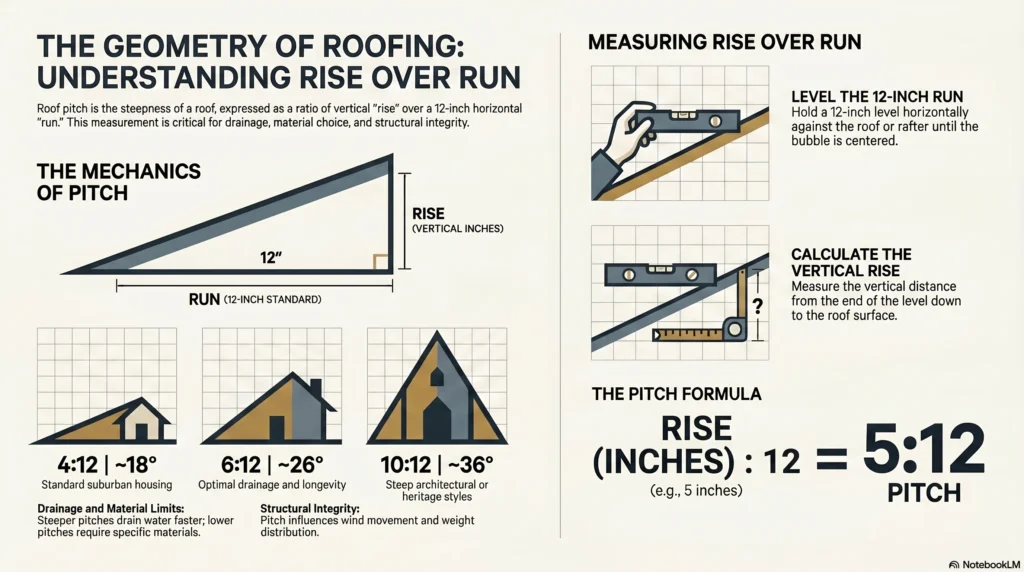
In other words, the roof pitch is the steeper your roof is. It is a ratio of the height of the roof to the distance it covers horizontally.
It will most often be expressed in a ratio, such as:
- 4:12
- 6:12
- 8:12
That first number is the rise. The second is the run, always 12 inches. Then a 4:12 pitch implies that the roof would rise 4 inches for every 12 inches across it.
The more that initial figure, the steeper the roof.
This one number touches just about everything:
- How fast does rain run off
- What kind of shingles or tiles can you use?
- How long does the roof last?
- How tricky it is to install
- Whether your gutters can keep up
- What the house looks like from the street
Rise Over Run: The Simple Idea Behind It All
It’s really just two measurements.
- Rise is the vertical climb.
- Run is the horizontal distance.
We always use a run of 12 inches in roofing.
If your roof goes up 6 inches over that 12-inch horizontal distance, then you have a 6:12 pitch. It is a good middle ground. Steep enough to let water run off without thinking twice.
Why Should You Care About Roof Pitch?
It’s not just numbers on paper. Roof pitch changes how your whole roof behaves.
Water Needs to Move
Sydney gets rain. A lot of it. If your roof is too flat, water hangs around. That’s when problems start—leaks, rot, mould, all that expensive stuff.
A steeper roof drains quickly. It hits the tiles and is heading to the gutters. That’s exactly what you want.
Your gutters also depend on the pitch in order to get that water. In case the right side of the angle, all goes well. When it is off, you may have overflow or blockages.
In the Blue Mountains, where the rain is unremitting, you will see that most roofs are inclined a little steeper, on account of this very reason.
Not Every Material Works on Every Pitch
You can’t just put any roof on any house.
Metal panels? Fine on lower slopes.
Concrete or terracotta tiles? They need a bit more angle.
Slate? Definitely needs a decent pitch.
Get it wrong, and water can work its way underneath. That’s a fast track to big repair bills. If you are planning a roof replacement project in Sydney, knowing your pitch before you start saves you from choosing the wrong materials.
Wind and Weight
Roof pitch changes how wind moves over your house. Near the coast around Wollongong, that matters. Too steep and you catch more wind. Too flat and water pools. It’s a balancing act.
The pitch also affects how the weight sits on the frame. Steeper roofs put different stresses on the structure. Good designers think about all of this.
It Changes the Whole Look of Your House
You can spot a roof pitch from the street without even thinking about it.
Low pitches look modern and sleek. You see them on contemporary homes.
Medium pitches are everywhere—your standard suburban street.
Steep pitches feel older, more traditional. Heritage homes, places in the mountains.
In Penrith and the Blue Mountains, you’ll see plenty of steeper roofs. They suit both the weather and the style of the area.
Measuring Roof Pitch Yourself (If You’re Comfortable)
Only basic tools are needed. But honestly? Only do this if you’re steady on a ladder. If heights aren’t your thing, skip to the professional section.
You’ll need:
- Tape measure
- A level (12-inch is easiest)
- Pencil
- Ladder
- Calculator
- Sturdy shoes
Someone to spot you if possible
Step 1: Set Up Safely
Get the ladder on solid ground. Check it’s secure. Have someone hold it if you can. And for goodness’ sake, don’t do this in the rain or wind.
Step 2: Get Into Position
Two ways to do this.
On the roof: Climb up carefully and work near the edge.
In the attic: This is actually safer. You can measure the rafters from inside, out of the weather and away from the edge.
Step 3: Get the Level Horizontal
Hold your level flat against the roof slope. Watch the bubble—it needs to be dead centre. That means the level’s perfectly horizontal.
Step 4: Find Your Rise
Keep that level exactly where it is—still horizontal, bubble centred. Now grab your tape measure.
At the point that’s 12 inches along the level (the end), measure straight up from that spot to the roof surface. Don’t angle the tape—keep it vertical.
That vertical distance? That’s your rise.
Let’s say you hold the tape up and it reads 5 inches. That means your roof rises 5 inches for every foot it runs.
So your pitch is 5:12. Simple as that.
Step 5: Double-Check
Roofs aren’t always even, so for that measure from a couple of spots and take the average.
The Formula (It’s Easy)
Roof Pitch = Rise ÷ Run
Since we always use 12 inches for the run, your rise measurement gives you the pitch.
If you measure 7 inches of rise over 12 inches of run:
Pitch = 7:12
What Pitches Are Common Around Sydney?
Here’s what you’ll typically find in homes across Sydney and nearby areas.
Pitch Angle Where You See It
| Roof Pitch | Roof angle | Common use |
| 3:12 | ~14° | Flat-looking modern roofs |
| 4:12 | ~18° | Your average suburban house |
| 5:12 | ~22° | Common with tile roofs |
| 6:12 | ~26° | Drains well, lasts well |
| 7:12 | ~30° | Steeper homes, better for rain |
| 8:12 | ~34° | Older-style or heritage homes |
| 10:12 | ~36° | Architectural, steep pitches |
Most homes around Sydney sit somewhere between 4:12 and 6:12. It’s a sweet spot—drains properly, costs about right to build, and looks normal.
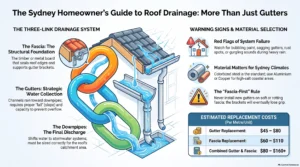
Gutters and Pitch: They’re Connected
Your roof pitch affects how your gutters perform. It’s simple physics.
A steeper pitch means faster water flow. That water hits the gutters with more speed and keeps moving through the downpipes. Debris gets washed away instead of sitting there. It may accumulate, strain the gutters, and expose them to overflow.You might also need bigger gutters to handle the large volume in case you are residing in a place that receives a large number of storms.
To ensure that all is fine, good roofers consider the pitch and the size of the gutter as a unit. This is where experienced roofing solutions in Sydney really prove their value.
What Happens If You Get the Measurement Wrong?
Measuring yourself is fine for a rough idea. But if you’re planning actual work, mistakes matter.
- Wrong materials – You might buy tiles that need a steeper slope.
- Bad installation – Roofers need accurate numbers to do the job properly.
- Gutter problems – Get the pitch wrong, and water might miss the gutters entirely.
- Renovation issues – Adding an extension? The new roof has to match.
That’s why most people eventually call in someone who does this every day.
Why Bother Getting a Pro?
A professional roof inspection gives you more than just a pitch number.
Roofers use proper gear—digital gauges, laser measures—that are way more accurate than a level and tape measure. They also know what to look for beyond the angle.
They’ll check:
- The condition of your tiles or sheeting
- Flashing and seals
- Gutter alignment
- Whether the structure underneath is sound
Companies like Aus Topline Roofing do this across Sydney and the surrounding areas. They’ll give you a proper assessment of not just the pitch, but whether your roof is actually doing its job. If they recommend a roof replacement Sydney job down the track, you will know the advice is based on accurate measurements.
When Should You Check Your Roof Pitch?
A few situations where it’s worth knowing:
- Putting on a new roof
- Replacing old materials
- Getting new gutters
- Installing solar panels
- Adding skylights
- Doing any kind of roof renovation
Contractors will ask for this information. Having it ready saves time and avoids mistakes.
Wrapping It Up
Pitch of the roof is not a mere technicality. It influences the way your home can withstand rain, what you are able to use, and the efficiency of your roof.
The rise over run idea is simple enough to understand. With a ladder and a level, you can get a rough idea yourself. Just be careful up there.
Yet since pitch has so many implications on the safety, drainage, and structural integrity, it is worth a professional confirmation. Particularly in such a climate as that of Sydney, where Sydney roofs must be able to cope with actual weather.
Whether you have a roofing job ahead or you just wish to have everything checked, it will be prudent to speak to a professional roofer. The first time, they will do it right.